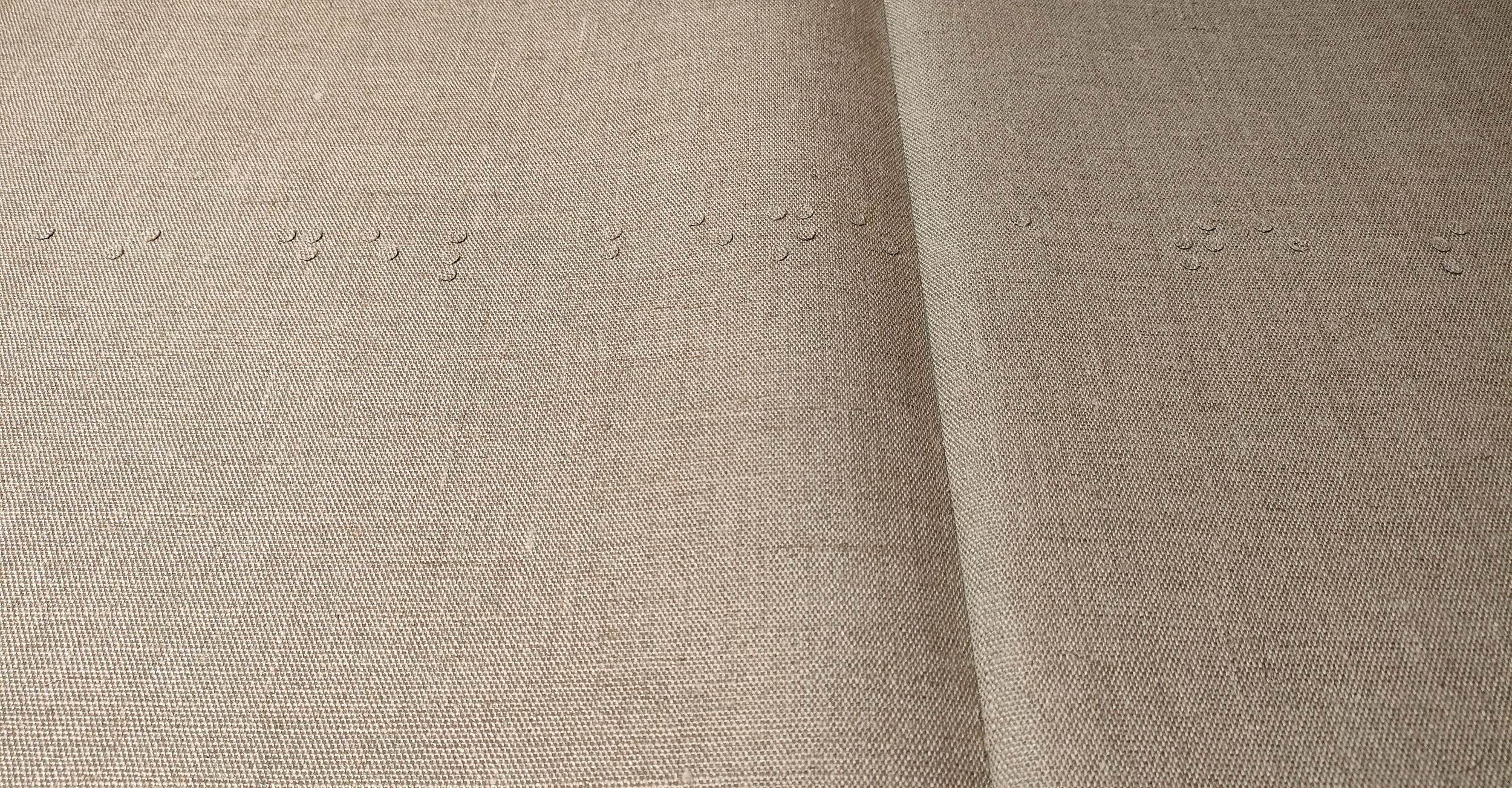
Il Libro del Padre, dettaglio.
Marco Cassarà | I Libri della Trasmigrazione (The Books of Transmigration)
by Giusi Diana
Text for the catalog of the exhibition “Time: Mask and Unmask”, curated by Viviana Vannucci and Moinuddin Khaled, Palazzo Pisani-Revedin, National Pavilion of Bangladesh, 59th International Art Exhibition, La Biennale di Venezia.
In an essay on the Lithuanian painter and musician Mikalojus Kostantinas Čiurlionis, the critic Vjačeslàv Ivanov wrote the following: The centrifugal inclinations of solitary artists do not lead them involuntarily into a vacuum, where new worlds of forms could be formed, but into vague solar systems, into the territories of the muses, and invoke ambiguous hybrid forms of creation, which result not in artibus, but inter Artes.1 Marco Cassarà’s pictorial research implicitly feeds on the same suggestions, and in fact moves in the sphere of symbolic abstraction, and his sources of inspiration are of various kinds: literary, doctrinal and philosophical above all, but also musical. Hybrid forms of creation and vague solar systems come towards us in his works, connecting microcosm and macrocosm. The universal key to accessing a world which would otherwise be down to subjective intuition, is however the mystical power of color, terse and iridescent and in continuous motion. This is what happens in Il Libro della Madre (The Book of the Mother) and Il Libro del Padre (The Book of the Father), a diptych that is part of the series of I Libri della Trasmigrazione (The Books of Transmigration): two artist’s books, conceived as spectrograms that materialize the “light” of the innermost, through precious chromatic outcrops, sometimes acidic and psychedelic. They inscribe mobile forms onto the conventional space of the page, captured just before their transformation into something else, like the fantastic dances starlings draw in the sky. The inner resonance becomes physical through the evocative power of a vast chromatic range, explored with abandon and visionary, entering into a vibration with our spiritual intelligence, a sort of dormant awareness, an ancestral analogical memory that acts through the psychic medium.
The diptych on display is made up of two “livres de peintre”, two books in which the paper of the pages replaces the canvas, suitable for receiving the liquid paint of glazes and being abraded by the electric grinder. The Book of the Mother is made up of 15 oil paintings on canvas alternated with 16 frottages made with charcoal dust; The Book of the Father is made up of 12 oil paintings on linen, in which a text, invisible at first sight, is present on the back of each canvas. These are short sentences in Braille alphabet, a tactile writing system developed in the first half of the 19th century and still in use. By passing one’s fingers on the embossed fabric one can “read” some philosophical exhortations without using one’s sight. In the central part of the book, nestled between two ultramarine blue paintings, the phrase “Know thyself” is reported in Braille.
Cassarà’s work has always moved in a liminal space, attempting to grasp the unimaginable through physical means. The result, by contrast, is a sign painting in bright colors, which seem to light up from within. This photonic brightness, together with the continuous fluctuation of the sign, gives the works an electronic aura, typical of fluid digital images. In this new series of works the intimate dimension of the book, a form which has always been dear to the artist, acquires solemnity thanks to the larger format which allows for a more immersive aesthetic experience. Even the philosophical reflection on the nature of the soul and its transmigration into the body finds an exact counterpoint in the materials used for the books – not only the canvas and the pigments, but also the leather that binds them in their two covers. In these works, the skin returns: organic corporeality, not pictorially represented in the form of a simulacrum, but present as a body and as a warning.
1 Vjačeslàv Ivànov, “Čiurlionis and the Problem of the Synthesis of the Arts”, on Luca Quattrocchi M.K. Čiurlionis: preludio all’astrattismo, Pendragon Edition, Bologna, 2000
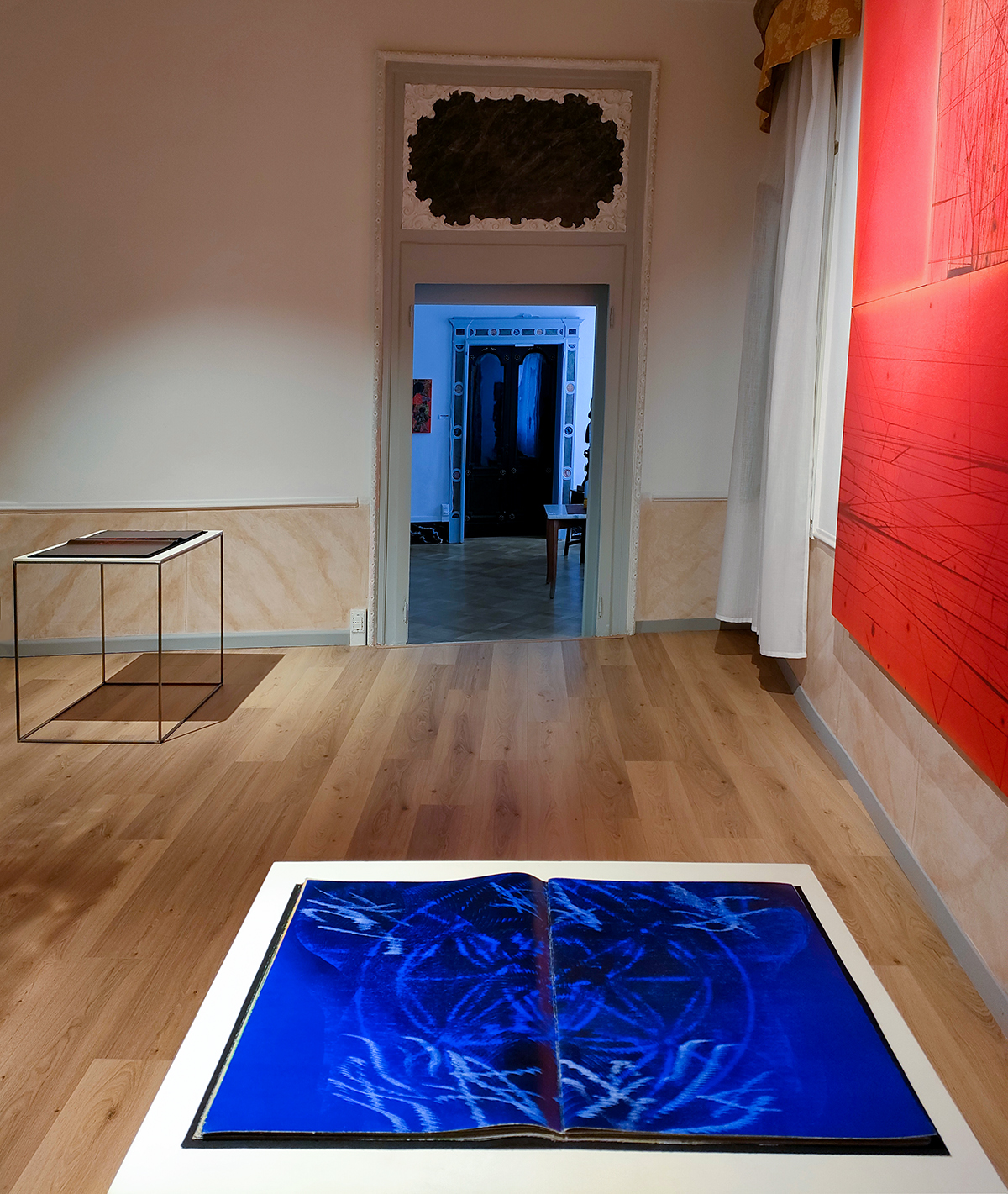
Installation view “Time: Mask and Unmask”, Palazzo Pisani-Revedin, National Pavilion of Bangladesh,
59th International Art Exhibition, La Biennale di Venezia.